
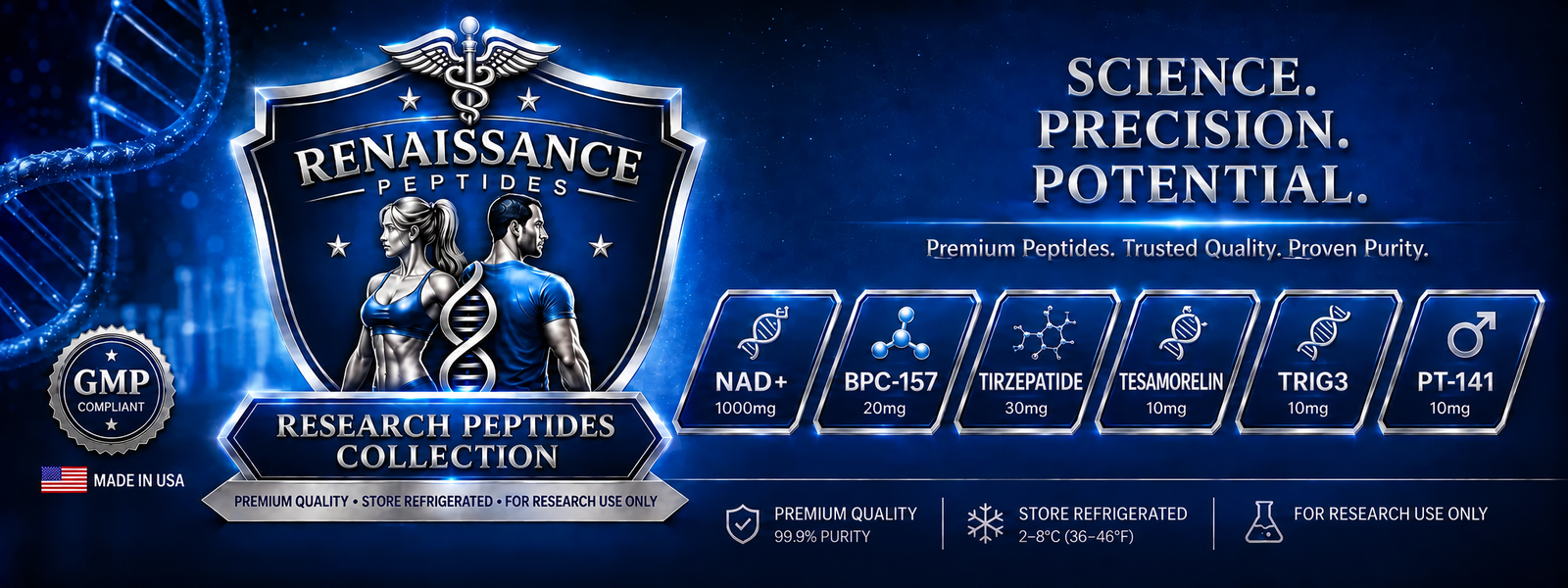
RENAISSANCE PEPTIDES
Research • Renew • Reinvent
GHK-Cu — 100 mg
A naturally occurring copper-binding peptide complex widely investigated in laboratory research involving cellular signaling, extracellular matrix activity, collagen-related pathways, and tissue biology.KLOW Blend — 70 mg
A multi-component research blend designed for laboratory investigation of peptide pathways associated with cellular repair, inflammatory signaling, tissue response, and skin-related biological processes. Exact ingredients should be listed separately on the product page.MOTS-C — 20 mg
A mitochondrial-derived peptide studied for its potential role in cellular metabolism, mitochondrial signaling, glucose utilization, energy regulation, and metabolic adaptation.NAD+ — 1000 mg
Nicotinamide adenine dinucleotide is a naturally occurring cellular coenzyme involved in energy metabolism, mitochondrial function, redox reactions, and numerous cellular processes.Sermorelin Acetate — 10 mg
A synthetic analog of growth hormone-releasing hormone (GHRH) used in research examining pituitary signaling and the biological pathways involved in growth hormone release.IGF-1 LR3 — 1 mg
A modified form of insulin-like growth factor-1 developed with an extended biological half-life. It is studied in laboratory research involving cellular growth, protein synthesis, metabolism, and IGF signaling pathways.Tesamorelin — 10 mg
A synthetic growth hormone-releasing hormone analog studied for its interaction with GHRH receptors and its effects on growth-hormone and metabolic signaling pathways.PT-141 (Bremelanotide) — 10 mg
A melanocortin receptor agonist studied for its activity within melanocortin signaling pathways, including neurological pathways associated with sexual response.MT-2 (Melanotan II) — 10 mg
A synthetic melanocortin peptide investigated for its interaction with melanocortin receptors and pathways associated with pigmentation and other melanocortin-mediated biological processes.TRIG3 — 20 mg / 10 mg
An investigational peptide that acts on GLP-1, GIP, and glucagon receptors. Research has focused on metabolic signaling, energy balance, glucose regulation, and body-weight-related pathways.TB-500 — 20 mg
A research peptide associated with thymosin beta-4 biology and studied experimentally in relation to cell migration, cytoskeletal activity, angiogenesis, and tissue-repair pathways.Bacteriostatic Water — 3 mL
Sterile bacteriostatic water containing a preservative and intended as a laboratory/reconstitution product where appropriate. Product labeling should clearly specify its composition and intended research use.BPC-157 — 20 mg
An experimental peptide studied primarily in preclinical research involving gastrointestinal biology, angiogenesis, inflammatory signaling, connective tissue, and tissue-repair mechanisms.Semaglutide — 40 mg
A GLP-1 receptor agonist extensively studied for its effects on glucose regulation, appetite signaling, gastric emptying, insulin secretion, and metabolic pathways.Tirzepatide — 50 mg / 30 mg
A dual GIP and GLP-1 receptor agonist studied for its effects on glucose metabolism, insulin signaling, appetite regulation, and energy-balance pathways.Kisspeptin — 10 mg
A naturally occurring signaling peptide studied for its role in the hypothalamic-pituitary-gonadal axis and its relationship to reproductive hormone signaling.SS-31 — 20 mg
Also known as elamipretide, SS-31 is a mitochondria-targeting peptide investigated for its interaction with mitochondrial membranes, cellular energetics, and oxidative-stress-related pathways.GLOW Blend — 70 mg
A multi-component research blend intended for laboratory investigation of pathways associated with skin biology, collagen signaling, cellular repair, and tissue response. Exact ingredients should be identified on the individual product listing.CJC-1295
A synthetic analog of growth hormone-releasing hormone (GHRH) studied for its interaction with pituitary signaling and pathways involved in growth hormone and IGF-1 regulation.Ipamorelin
A selective growth hormone secretagogue investigated for its activity at the ghrelin receptor and its influence on growth hormone signaling.CJC-1295 + Ipamorelin
A research combination frequently studied for the complementary interaction between GHRH-receptor and ghrelin-receptor signaling pathways involved in growth hormone release.Thymosin Alpha-1 (TA-1)
A naturally occurring thymic peptide studied for its role in immune-system signaling, T-cell activity, and regulation of innate and adaptive immune responses.LL-37
A naturally occurring antimicrobial peptide involved in the body’s innate immune system. Laboratory research examines its antimicrobial activity, immune signaling, inflammation, and cellular responses.KPV
A short peptide fragment associated with alpha-melanocyte-stimulating hormone (α-MSH). It is investigated in preclinical research involving inflammatory signaling, immune response, and gastrointestinal and skin biology.Semax
A synthetic peptide investigated primarily in neurological research involving neurochemical signaling, neuroplasticity, cognition, and cellular responses within the nervous system.Selank
A synthetic peptide derived from the naturally occurring peptide tuftsin. Research has examined its interaction with neurological and immune signaling pathways, including mechanisms associated with stress and cognition.DSIP (Delta Sleep-Inducing Peptide)
A naturally occurring neuropeptide investigated experimentally in connection with sleep regulation, neurological signaling, stress-response mechanisms, and circadian biology.Epitalon (Epithalon)
A synthetic tetrapeptide investigated in experimental aging and cellular research, including studies involving melatonin signaling, circadian biology, telomere-related mechanisms, and cellular longevity.AOD-9604
A modified fragment of human growth hormone investigated in metabolic research, particularly pathways involving lipid metabolism and fat-cell biology.5-Amino-1MQ
A small-molecule NNMT inhibitor rather than a peptide. It is studied experimentally for its effects on nicotinamide metabolism, cellular energy regulation, and metabolic pathways.Dihexa
An experimental compound studied in neurological research involving synaptic signaling, neuronal connectivity, and mechanisms associated with learning and memory. Dihexa is not technically a conventional peptide despite often being grouped with research peptides.Pinealon
A short synthetic peptide investigated in experimental neuroscience and aging research, including cellular signaling and neurological processes associated with cognitive and circadian function.Glutathione
A naturally occurring tripeptide composed of glutamate, cysteine, and glycine. It plays an important role in cellular redox balance and is widely studied in research involving oxidative stress and antioxidant systems.Research Use Disclaimer
Products offered by Renaissance Peptides are intended for laboratory and research purposes only. They are not intended for or for use in the diagnosis, treatment, cure, or prevention of disease. Product descriptions summarize areas of scientific investigation and are not statements of therapeutic effectiveness.